
Snake Mites (Ophionyssus natricis): Facts & Biology
Snake Mites Facts: Global Distribution & Prevalence
Snake mites facts are important for every keeper to understand. The snake mite, Ophionyssus natricis, is a cosmopolitan parasite found worldwide. While over 250 species of mites and ticks have been identified as reptile parasites, O. natricis is by far the most common and destructive pest affecting captive snakes and, occasionally, lizards.
Ophionyssus natricis Snake mite Source Wikipedia
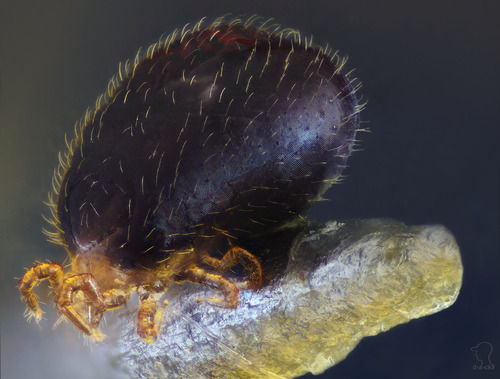
Life Cycle & Reproduction
Under favorable conditions (temperatures of 24–29°C / 75–85°F and moderate humidity), the life cycle is remarkably fast:
Development Time: The cycle from egg to adult can be completed in just 13–19 days. At cooler temperatures (20°C), it may extend to 32 days.
Egg Laying: Engorged females lay approximately 20 eggs per batch. A single female produces 60 to 80 eggs in her lifetime, typically depositing them in dark, humid crevices of the enclosure rather than on the snake itself.
Lifespan: Adult females typically live 5–6 weeks. The claim of a one-year lifespan is inaccurate for the active parasitic stage.
Dormancy: While larvae are fragile and short-lived, the deutonymph stage and adults can survive off-host in the environment for 40 days to 3 months without a blood meal, making eradication difficult if the enclosure is not thoroughly treated. They do not remain dormant for years.
Impact on Snakes

Ophionyssus natricis Snake mite Photo provided by Dr. Doug Mader
Mites embed themselves under scales to feed on blood. Heavy infestations lead to:
Anemia: Visible as pale or white mucous membranes (normal is pink).
Stress & Dermatitis: Causes lethargy, excessive soaking, irregular shedding (dysecdysis), and crusting of the skin.
Disease Vector: O. natricis is a confirmed mechanical vector for deadly pathogens, including Inclusion Body Disease (IBD) in boas and pythons (caused by Reptarenavirus) and Aeromonas bacteria (causing mouth rot/septicemia).
Zoonotic Potential (Risk to Humans)
Transmission to humans is possible. While mites cannot reproduce on humans, they will bite when hosts are scarce.
Symptoms: Bites cause papular vesiculo-bullous eruptions—itchy, red blisters or pustules, often on the arms or hands of keepers.
Nature: These are irritant reactions to the bite, not an allergic sensitization, and typically resolve once the infestation is cleared
Transmission & Prevention
Infestations usually enter a collection via:
New Acquisitions: The highest risk factor. Newly acquired snakes often carry hidden mites or eggs.
Contaminated Items: Prey animals, substrate, plants, or wooden hides from infested sources.
Cross-Contamination: On clothing or hands after visiting reptile shows or pet stores.
Critical Prevention Step: Always quarantine new animals in a separate, bare-bottom enclosure for at least 30–40 days before introducing them to your main collection. This breaks the life cycle and prevents environmental contamination.
Key takeaways:
Snake mites (Ophionyssus natricis) are the most common and destructive parasite for captive reptiles.
Mites are mechanical vectors for deadly diseases like Inclusion Body Disease (IBD) and mouth rot.
A strict 30-40 day quarantine for new acquisitions is the most effective way to prevent collection-wide infestation.
For a step‑by‑step guide to using predatory mites as a safe treatment, see our page on Predatory snake mites biological control.
We hope this information helps. Thank you for your time. Best of luck,
Living Art Reptiles™.
Source Information: Living Art Reptiles, Mendoza-Roldan, J. A., et al. (2024), Schilliger, L. H., et al. (2019), Schilliger, L. H., et al. (2023), Wildlife Health Australia. (2018), and Amanatfard, E., et al. (2014).
Photos: Dr. Doug Mader & Wkikipedia.
-
Disclaimer: please read before using this site. Any information posted on this web site is for general entertainment and educational purposes only, and should not be construed as medical advice, medical opinion, diagnosis or treatment. Any information provided by this web site is not a substitute for actual medical attention. Always promptly consult your licensed veterinary health-care professional for your pet's medical advice and treatment.
Experience Living Art!
Design 1988-2026, Living Art Reptiles™, Content 1988-2026 Living Art Reptiles™; Unless otherwise stated.