
Ball Python Maternal Incubation Guide: A Step-by-Step Approach
What Is Ball Python Maternal Incubation Guide?
This ball python maternal incubation guide explains the natural process where a female snake coils around her eggs and uses shivering thermogenesis — rhythmic muscle contractions — to generate body heat and warm the clutch. She also regulates humidity and protects the eggs from disturbance for the entire incubation period.
This behavior is most well-documented in pythons (Ball Python, Carpet Python, Reticulated Python, Emerald Tree Boa, and others). Some viper species also show limited nest attendance.
Note: This guide covers the full timeline from mating through post-hatch. If you're incubating eggs artificially in vermiculite or perlite, see [Vermiculite & Perlite for Incubating Snake Eggs].
Before you dive in, ask yourself: “Should I even be doing this?” Maternal incubation is best suited for experienced keepers with females that are fully grown, in excellent body condition, and already thriving under consistent husbandry. If you’re a first-time breeder, still dialing in your care, or your female is young, underweight, or recovering from any health issue, you should not attempt this yet. Use a standard incubator for now and come back to maternal incubation once you and your animals are ready.
Step 1: Mating (The Lock)
-
The male and female align and the males hemipenes transfer sperm into the females cloaca. This is the "lock."
-
Mating may occur multiple times over several weeks — one lock does not guarantee fertility.
-
The female stores sperm in her oviducts. She can retain viable sperm for months to over a year, so a single successful lock can result in fertile eggs even if no further matings occur.
-
What to do: Note the date of the first lock. Plan on 4–6 weeks of continued pairing (or at minimum, 2–3 locks) before expecting eggs.

Ball Python Breeding lock Photo Living Art Reptiles
Step 2: Follicle Development (The Waiting Period)
After the final lock, the female's ovarian follicles grow over the next several weeks.
-
Ball pythons: Follicles grow to ~40 mm before ovulation. Total time from last lock to ovulation is typically 4–7 weeks.
-
Carpet pythons: Similar timeline, though variable.
-
Signs to watch for:
-
The female becomes noticeably swollen, especially around the midsection
-
She may become less active or more reclusive
-
She may refuse food (normal — don't force-feed)
-
She may begin cool-seeking (staying on the cool side of the enclosure, wrapping around water bowls)
-
Some females lie inverted (upside down) on the floor of the enclosure
-
Tip: If you're unsure whether she's ovulating, an ultrasound at a reptile vet can confirm follicle size.
Step 3: Ovulation
Ovulation is the moment the follicles rupture and the eggs (now fertilized) enter the oviduct to be shelled.
-
How to recognize it: The female will swell dramatically — often described as looking like she "swallowed a jumbo rat." Her body becomes hard and rigid. She may appear uncomfortable or agitated.
-
What to do:
-
Remove the male if he's still in the enclosure
-
Do not handle or disturb the female
-
Expect the pre-lay shed within 2–3 weeks (ball pythons: ~16 days)
-
Begin preparing the nesting area (see Step 5)
-

Ball Python Breeding Ovulation Photo Joe Compel
Step 4: Pre-Lay Shed
A few weeks after ovulation, the female will shed her skin. This is the pre-lay shed — the most reliable countdown marker for egg-laying.
-
Ball pythons: Eggs are typically laid 27–32 days after the pre-lay shed
-
Carpet pythons: Similar range
-
Signs it's approaching:
-
The shed will be clean and complete (not patchy)
-
The female may become restless, dig at substrate, or explore the enclosure
-
She may seek out a hiding spot or nest box
-
Key rule: The pre-lay shed date is your best starting point for counting down to egg-laying. Mark it on your calendar.
Step 5: Nesting & Egg Laying
Preparing the Nest
Before the pre-lay shed, set up a nesting box in the enclosure:
-
A container (plastic tub, wooden box) with a shallow layer of damp sphagnum moss or a mix of moss and inert substrate
-
The box should be deep enough for her to curl around the eggs but not so large she loses contact with them
-
Place it on the warm side of the enclosure
-
Ensure the enclosure has a stable temperature (for ball pythons: 88–92°F / 31–33°C) and humidity of 60–80%
-
Minimize disturbances — no moving furniture, loud noises, or frequent handling
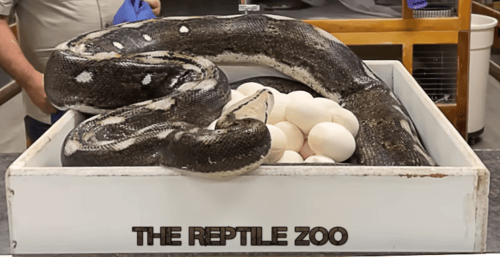
Python Incubation nesting box Photo The Reptile Zoo
The Laying Event
-
Once she begins laying, she should deposit all eggs within 24 hours
-
Eggs are typically leathery, cream or pale yellow, and may be fused to each other
-
Do NOT remove the eggs. Leave her with them.
-
If she has difficulty laying (stopping for more than 24 hours), contact a reptile veterinarian

Ball Python Snake Laying Eggs Living Art Reptiles
Step 6: Maternal Incubation Begins
Once the last egg is laid, the female will coil tightly around the clutch and begin incubating.
What She Does
-
Coils around the eggs, wrapping her body to maintain contact
-
Shivers — rhythmic muscle contractions that generate heat (this is shivering thermogenesis, unique among ectotherms)
-
Regulates temperature by tightening or loosening her coils
-
May leave briefly to bask, drink water, or (in some species) feed
-
Refuses food for much or all of incubation (normal — do not force-feed)
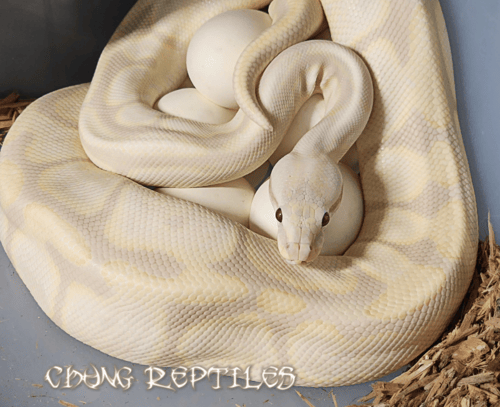
Ball Python Maternal incubation with clutch of eggs Photo Chung Reptiles
What You Do
Incubation Timeline
Maternally incubated clutches typically hatch within the same range as artificially incubated ones — the mother is remarkably consistent.
Step 7: What to Look Out For (Troubleshooting)
Signs Everything Is Going Well
-
She remains coiled around the eggs, only leaving briefly
-
She is calm and unbothered by your brief checks
-
The eggs look plump and smooth
-
She may occasionally shift position but re-coils immediatel
Warning Signs
Abandonment
Abandonment is rare in healthy, well-conditioned females but can happen if:
-
The female is too young or underweight (for ball pythons, avoid maternal incubation for females under 4 years old or under ~4 lbs / 1,800 g)
-
She is stressed (frequent handling, temperature fluctuations, loud noise)
-
Her body condition is poor — if she's not in peak shape, her instinct may shift to self-preservation
Prevention: Only allow females in excellent condition to maternally incubate. Give her at least one full season off from breeding after a maternal clutch.

Ball Pythons egg clutch not fully collected and coiled Photo Living Art Reptiles
Step 8: Hatching
Signs Hatching Is Near
-
Eggs dimple, wrinkle, and become soft (the shell loses rigidity as the embryo resorbs calcium)
-
You may see dark spots inside the egg (the developing snake's body)
-
The mother may loosen her coils slightly
-
You may occasionally hear faint tapping or movement from inside the eggs — though this is subtle and not always noticeable.
The Hatch
-
The first hatchling uses its egg tooth to make a small hole ("pipping")
-
The baby may remain in the egg for hours to up to 3 days, absorbing the remaining yolk sac
-
The mother will not squish the hatchlings — she adjusts her coils to let them breathe
-
The entire clutch may take a few hours to 3 days to fully emerge
-
Do not assist the hatchlings out of their eggs unless a baby is clearly stuck and not progressing after 48+ hours

Ball Python baby hatchling egg tooth pipped Living Art Reptiles

Ball Python Hatchlings Maternal incubation Photo Chung Reptiles
What to Do at Hatch
-
Wait until ALL babies have fully emerged from their eggs
-
Gently uncoil the mother and move her to a clean, separate enclosure
-
Move the hatchlings to a clean hatchling enclosure with appropriate temperature, humidity, and hiding spots
-
Soak the mother in a warm bath and offer a small meal a few days later (she may refuse for a week or more — this is normal)
-
Clean the nest box thoroughly

Fully emerged hatctchling baby Ball Python Photo Living Art Reptiles

Fully emerged clutch of baby Ball Pythons Photo Living Art Reptiles

Baby hatchling setup Photo Living Art Reptiles
Step 9: Post-Hatch & Recovery
For the Hatchlings
-
Provide a separate enclosure with a temperature gradient (warm side ~88–90°F, cool side ~80–82°F for ball pythons)
-
Humidity: 60–80%
-
Offer a small, appropriately sized prey item after their first shed (usually 1–2 weeks post-hatch)
-
Do not handle heavily for the first week
For the Mother
-
She will be significantly depleted after a maternal clutch
-
Offer small meals every 2–3 days; she may refuse for 1–3 weeks
-
Provide a warm, quiet environment for recovery
-
Do not re-breed for at least one full season (12 months)
-
Monitor her weight — she should regain her pre-breeding weight over the next few months
Quick Reference: Full Timeline (Ball Python Example)
Total: ~5 months from final lock to fully recovered mother and independent hatchlings.
Species-Specific Notes
-
Ball Python: Most commonly maternally incubated in captivity. Easiest species for this method. Requires a female in excellent condition (4+ years, 4+ lbs).
-
Carpet Python: Very reliable maternal incubators. Often leave to bask and return. Slightly longer incubation than ball pythons.
-
Reticulated Python: Longest incubation (80–90 days). Large clutches (40–80+ eggs). Requires a very large, experienced female.
-
Emerald Tree Boa: Smaller clutches, shorter incubation. Mother is less likely to leave the eggs.
-
Southern African Rock Python (Python natalensis): Notable for staying with hatchlings for ~2 weeks post-hatch to keep them warm while they absorb their yolk sacs (documented by Prof. Graham Alexander, Wits University).
Advantages & Disadvantages of Maternal Incubation
Final Tips
-
Start with one clutch. Don't attempt maternal incubation with every female you own.
-
Keep detailed records: date of last lock, date of ovulation (swelling), date of pre-lay shed, date of laying, number of eggs, date of hatch, number of hatchlings.
-
When in doubt, move the eggs to artificial incubation. A mother abandoning eggs is a last resort — but if you see clear signs of distress or neglect, don't wait.
-
Give her a break. A female that maternally incubates every year will decline. One season off is the minimum.
We hope this information helps. Thank you for your time. Best of luck,
Living Art Reptiles™.
Source Information: Living Art Reptiles, Joe Compel, and Bob Clark.
Photos: Living Art Reptiles, Joe Compel Reptiles, Chung Reptiles and The Reptile Zoo.
-
Disclaimer: please read before using this site. Any information posted on this web site is for general entertainment and educational purposes only, and should not be construed as medical advice, medical opinion, diagnosis or treatment. Any information provided by this web site is not a substitute for actual medical attention. Always promptly consult your licensed veterinary health-care professional for your pet's medical advice and treatment.
Experience Living Art!
Design 1988-2026, Living Art Reptiles™, Content 1988-2026 Living Art Reptiles™; Unless otherwise stated.